
Every once in a while, you get reminded of a lesson you already knew.
I had one of those experiences recently.
I knew a company and its owner for years. I liked the business. I could see the opportunity in front of them. And for a long time, I thought about how impactful EOS could be in helping them grow and build a stronger business.
When the opportunity finally came to work together, they looked like a great fit.
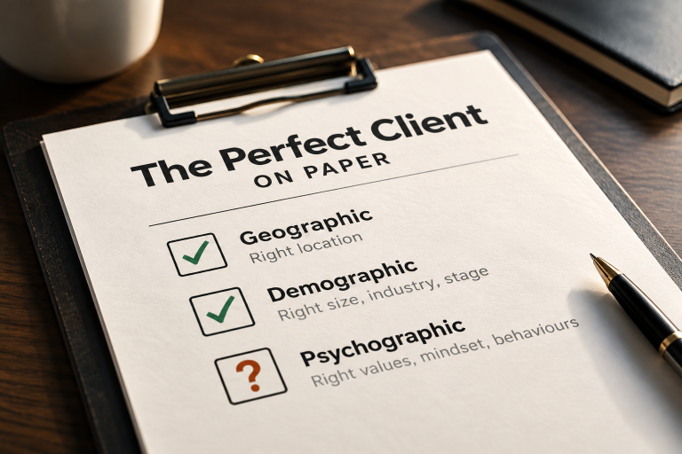
Right geography. Right size. Right stage of business. The kinds of challenges EOS is designed to help solve.
On paper, they checked the boxes.
But as the implementation progressed, it became increasingly clear to me that something wasn’t clicking.
Eventually, I realized why.
I had focused on the geographic and demographic fit and overlooked the psychographic fit.
The Part of Target Market We Sometimes Miss
When we help EOS clients define their Target Market, we encourage them to think about three things: geographic, demographic and psychographic characteristics.
Geographic and demographic are usually the easy ones.
Where are your ideal customers located? What industry are they in? How big are they? What other measurable characteristics identify the customers you are best equipped to serve?
Psychographics go deeper.
How do your best customers think? What do they value? How do they behave? What characteristics make working together productive and enjoyable?
Ironically, I spend a lot of time helping clients think through exactly these questions.
And then I overlooked them in my own business.
This company was a geographic fit. They were a demographic fit.
But we weren’t a strong psychographic fit.
And that matters enormously when implementing EOS.
You Can’t Want It More Than They Do
As EOS Implementers, we have a saying:
We can’t want it more than the client does.
That may have been my biggest learning from this experience.
I didn’t need the client. But I really wanted to help them.
I had known the business for years and could see what I believed was possible. In hindsight, I became so invested in that possibility that I wasn’t paying enough attention to whether they were equally invested in the process required to get there.
Keith Cunningham captures this idea well in his book The Road Less Stupid:
“When my effort to help you get better exceeds your effort to get better, this stops working for both of us.”
That’s true with employees. It’s true in coaching. And it’s certainly true when implementing EOS.
EOS requires a leadership team to be open and honest. It requires vulnerability, difficult conversations, accountability and a willingness to change.
An Implementer can create the environment for those things to happen.
We can’t make a leadership team want them.
Eventually, I felt I needed to raise the question neither of us had really asked:
Is this working, and does it make sense for us to continue?
That led to an open conversation, and ultimately we mutually agreed it was best to stop our work together.
No blow-up. No bad ending.
Just the recognition that sometimes two parties can both be good at what they do and still not be the right fit for one another.
Core Values Aren’t Just for Employees
The experience also reminded me of something we teach around Core Values.
We often think about Core Values primarily in the context of people. Do our employees fit our Core Values? Are we hiring, recognizing, rewarding and sometimes making difficult people decisions based on them?
But when you take Core Values to the next level, they can also help define the customers and vendors you want to work with.
One of the Core Values at EOS Worldwide is Humbly Confident.
I’ve always loved that one.
The best leadership teams I’ve worked with embody both sides of it. They’re confident enough to lead, make decisions and have strong opinions. But they’re also humble enough to remain open to another perspective, acknowledge when something isn’t working and challenge their own thinking.
Add openness, honesty, accountability and a genuine desire to get better, and you’re getting much closer to the psychographic profile of a great EOS client.
Those characteristics don’t show up as neatly in a CRM as geography, industry, employee count or revenue.
But they may matter more than all of them.
A Better Question
Whenever I meet with a prospective client, one of the questions running through my mind has always been:
Can I help them?
I still think that’s an important question.
But there’s another question I need to ask just as deliberately:
Are they ready to be helped?
Those are very different questions.
The first is about EOS and my ability.
The second is about their readiness.
You need both.
And maybe that’s the bigger lesson for any business.
Your ideal customer isn’t simply someone who needs what you sell, can afford it, lives in the right geography and fits the demographic profile you’ve created.
The best customers are the ones who also share the values, mindset and behaviours that allow you to do your best work together.
Sometimes the client who looks perfect on paper isn’t the right client at all.
And sometimes the hardest part is recognizing that before you start wanting it more than they do.