
Every growing business eventually hits a ceiling. The question isn’t whether it will happen—it’s whether leadership is willing to evolve fast enough to break through.
Most businesses don’t stall because of market changes, the economy, or a lack of innovation. They stall because leadership must evolve faster than the business does.
What got a company from $2 million to $5 million often won’t get it to $10 million, $20 million, or $50 million. The habits, structure, communication, and leadership style that once worked begin to create friction. Leaders feel stretched. Teams become reactive. Accountability gets fuzzy. Complexity creeps in.
And eventually, growth slows.
I saw this play out—and ultimately break open—with a company I started working with a few years ago.
Only two people sat in the room for our first session: the owner and his right-hand man. The company had about 20 employees at the time. They were only three years in, but they had already gone through an incredibly difficult season. About a year earlier, they had seriously questioned whether the business was viable long-term and had even discussed selling off the assets and moving on.
The start of the EOS journey wasn’t perfect. There were setbacks. Structure changes. Leadership changes. Their first integrator worked for a while, but eventually things fell apart.
But one thing the owner did exceptionally well was embrace the idea of delegating and elevating himself out of the day-to-day operations of the business.
Did he get it right every time? Not even close.
But he kept going.
Over the next several years, the company continually evolved its leadership structure, clarified accountability, and built out a true leadership team and management layer. I couldn’t tell you how many versions of the Accountability Chart they went through.
Today, the company is thriving. The business has more than tripled in size over the past four years and now has close to 70 employees. Profitability is strong. The leadership team is healthy. And perhaps most importantly, the owner genuinely loves the business again.
That’s the power of leadership evolution.
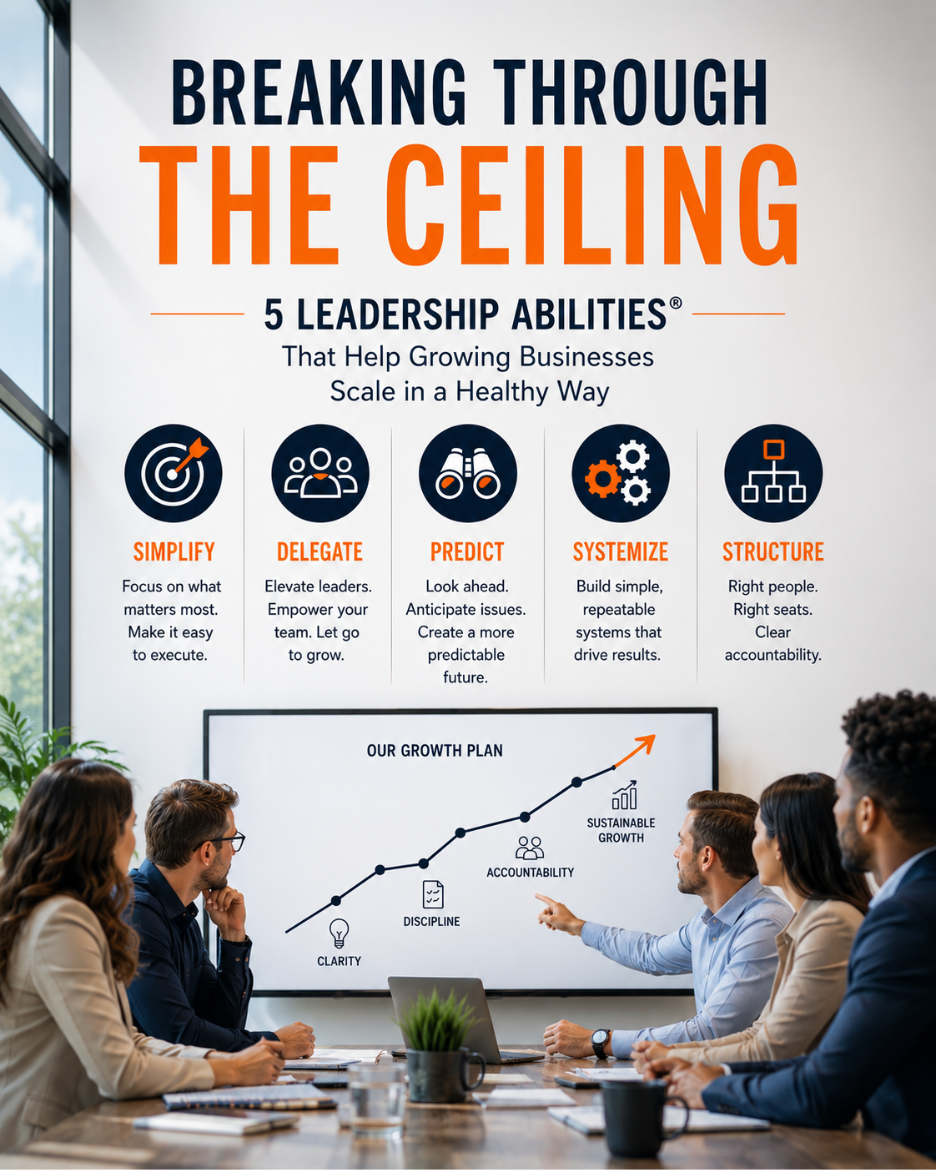
So how do leaders actually evolve? In Traction®, Gino Wickman identifies five leadership abilities required for breaking through ceilings and sustaining healthy growth. Over the years, I’ve seen these abilities consistently show up in the leadership teams that scale successfully.
1. Simplify
As businesses grow, complexity naturally increases. More people. More products. More meetings. More moving parts.
Strong leaders simplify. They clarify the vision. They narrow priorities. They create consistency. They make it easier for people to understand what matters most and how success is measured.
Simplicity scales. Complexity suffocates.
2. Delegate
This sounds obvious, but it’s one of the hardest abilities for entrepreneurial leaders to develop.
Many owners become the ceiling because they continue acting like the hero of the business. They stay involved in too many decisions, solve too many problems, and struggle to truly let go.
In last month’s blog, I wrote about the dangers of becoming the “genius with a thousand helpers.” Businesses eventually stall when too much depends on one person.
Delegation isn’t dumping tasks. It’s transferring ownership and trusting capable people with meaningful responsibility.
The owner in my story understood this deeply. He didn’t always get delegation right—but he never stopped working at it. He kept letting go, kept building leaders around him, kept getting out of his own way. That commitment to elevation, more than any single decision, is what unlocked the company’s growth.
Healthy growth requires leaders to let go of good so the organization can become great.
3. Predict
Reactive leadership is exhausting.
Strong leadership teams learn to see around corners. They anticipate issues before they become fires. They spot trends in the numbers. They recognize cultural drift early. They identify people problems before they damage the organization.
Predictability creates stability. Stability creates confidence. And confidence allows businesses to grow without constant chaos.
4. Systemize
When organizations rely too heavily on tribal knowledge or heroic effort, growth becomes fragile.
Leaders who consistently break through ceilings build systems. Not bureaucracy. Not unnecessary process. Just clear, consistent ways of doing the most important things exceptionally well.
Systems reduce friction, improve accountability, and create scalability.
5. Structure
Many businesses outgrow their structure long before they realize it.
Responsibilities overlap. Accountability gets blurry. The wrong people end up making key decisions. Sometimes leaders stay in seats they’ve outgrown—or the seat outgrows them.
Growth requires structure to evolve. The right people. In the right seats. With clear accountability.
This was the other unlock for the company I mentioned. They didn’t just delegate—they restructured. Again, and again. They were willing to look honestly at who was in which seat and whether the structure still fit the business they were becoming. That willingness to evolve the chart, even when it was uncomfortable, kept them from outgrowing their own organization.
Clarity creates momentum.
The truth is that every growing business will hit another ceiling.
The question is whether the leadership team is willing to grow enough to break through it.
Where is your business hitting a ceiling right now? And which of these five abilities needs the most attention?