
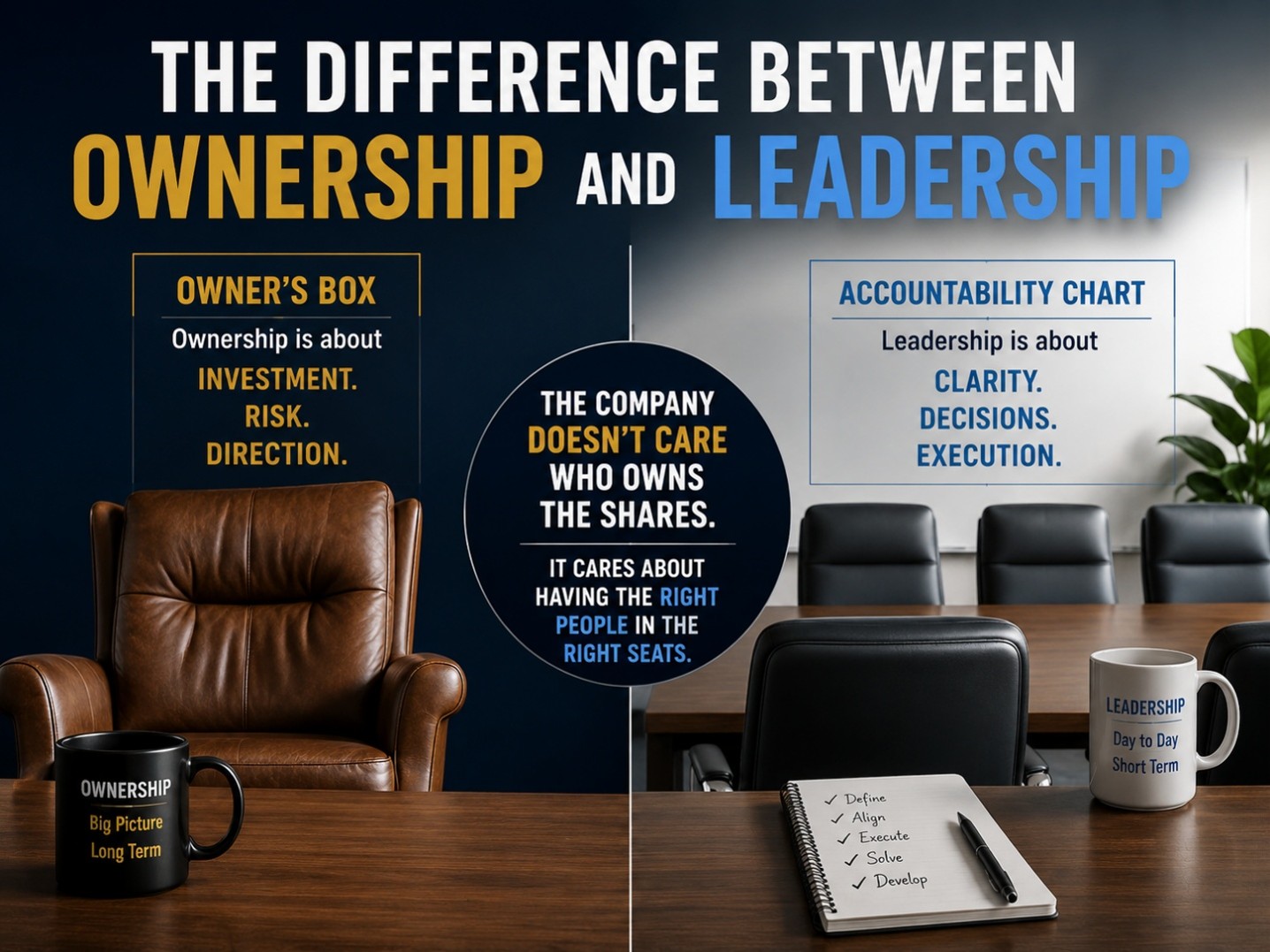
I facilitated a Focus Day with a new client that brought together a leadership team of four people, three of whom were owners.
As we worked through their Accountability Chart, something stood out.
The owners weren’t focused on protecting titles or preserving the current structure. Several times they talked about the need to challenge “sacred cows” and avoid falling into the trap of “it’s always been done that way.”
Instead, they kept coming back to a simple question:
What’s best for the company?
It struck me because that mindset is rarer than you might think.
In many entrepreneurial businesses, ownership and leadership become intertwined. The assumption is that if someone owns part of the company, they should automatically have a seat on the leadership team.
But ownership and leadership are not the same thing.
One of the most important reminders I give leadership teams when building an Accountability Chart is this:
The company doesn’t care who owns the shares.
The company cares about having the right people in the right seats.
Now, before you stop reading, I’m not suggesting ownership doesn’t matter. It absolutely does.
Owners invest capital. They take risk. They provide governance and help shape the long-term direction of the organization.
Those are incredibly important responsibilities.
But leadership is different.
Leadership is about creating clarity, making decisions, developing people, solving problems, and driving execution.
Sometimes the best leader in a particular seat is also an owner.
Sometimes they aren’t.
The business doesn’t benefit because an owner occupies a seat. It benefits when the right person occupies a seat.
That’s why one of the healthiest questions a leadership team can ask is:
If we were building this company from scratch today, what structure would best serve the business, and who would be the best people to fill those seats?
Notice what’s missing from that question.
It doesn’t ask who founded the company.
It doesn’t ask who has been here the longest.
It doesn’t ask who owns the most shares.
It simply asks what the business needs.
For some owners, the answer may be a seat on the leadership team.
For others, it may be contributing in a different role.
For some, it may be providing oversight and direction from the Owner’s Box without having an operational role at all.
All of those scenarios can work.
What matters is that the structure serves the company, not the other way around.
The companies that break through ceilings, scale effectively, and build strong leadership teams are often led by owners who understand this distinction.
They recognize that ownership and leadership are different responsibilities.
More importantly, they are willing to set aside ego, history, and titles in pursuit of something bigger:
Doing what’s best for the company.
That’s what impressed me most about this team.
Not their ownership structure.
Not their titles.
Not who reported to whom.
It was their willingness to challenge assumptions and ask the question every great leadership team should be asking.
Is your Leadership Team asking “What’s best for the company”?