
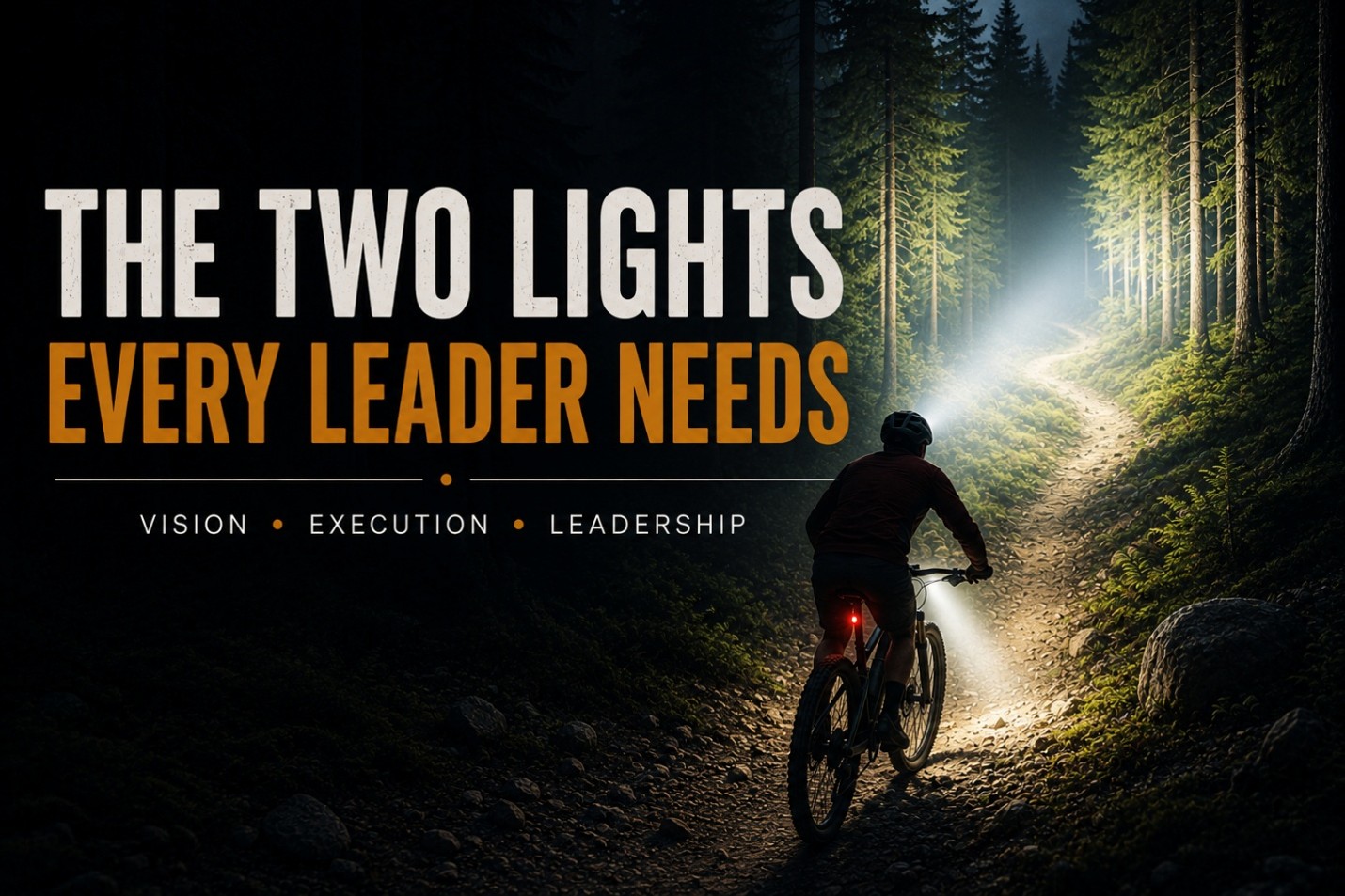
Every year, I race in a 24-hour mountain bike relay race. It’s one of my favorite weekends of the year. Along with the physical challenge, every rider has to complete at least one lap in the middle of the night. Each lap takes about an hour, winding through forest trails in complete darkness.
If you’ve never ridden a mountain bike through the forest at 3:00 a.m., it’s hard to appreciate just how dark it really is. Once you’re away from the start/finish area, there are no streetlights, no nearby houses, and very little moonlight making its way through the trees. Your world is only as big as the beam of light in front of you.
That’s why most mountain bikers ride with two lights.
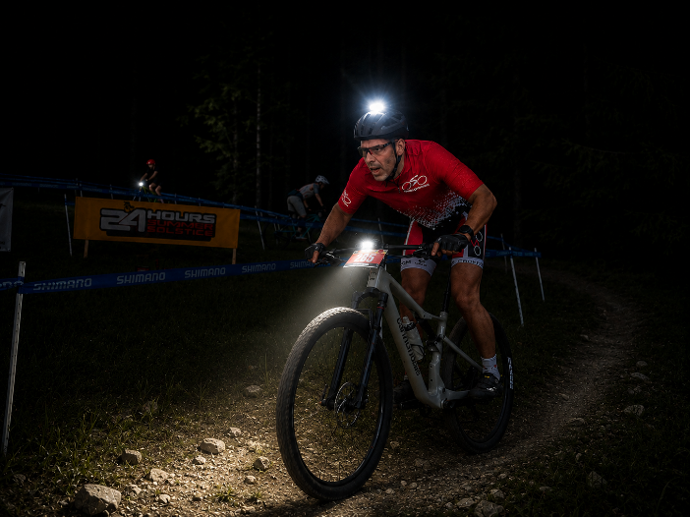
One is mounted on the handlebars. The other is mounted on the helmet.
They serve two very different purposes.
The handlebar light shines directly in front of your front wheel. It helps you avoid the rocks, roots, and obstacles immediately in your path.
The helmet light is brighter and shines wherever you’re looking. It lets you see farther down the trail, around upcoming corners, and anticipate sudden climbs, descents, or technical sections before you get to them.
This year, I found out the hard way just how important those two lights really are.
About halfway through my night lap, I noticed my helmet light beginning to wobble. The mounting bracket had broken, and the light was bouncing around enough that it was becoming difficult to see the trail. I assumed that was the problem, so I pulled off to the side of the trail expecting it to be a quick fix.
When I unplugged the helmet light from its battery…
everything went black.
That’s when I realized my handlebar light had already gone out. Its battery had died, but because my helmet light had still been providing enough light, I hadn’t noticed. Looking back, the reason the wobbling helmet light suddenly seemed so inadequate was because, without realizing it, I’d already lost the support of my handlebar light.
Standing alone in the middle of the forest at 3:00 in the morning, I couldn’t see the trail. I couldn’t see my bike. I couldn’t even see my hand in front of my face.
After a few minutes of fumbling around in complete darkness, I realized I could use the battery from my broken helmet light to power my handlebar light. Since the helmet mount was broken anyway, at least I could get one light working again.
I finished the rest of the lap with only my handlebar light.
That’s when I noticed something I’d never really appreciated before.
I could still ride.
The handlebar light gave me enough visibility to avoid the rocks and roots directly in front of my wheel.
But I couldn’t ride nearly as fast.
Without my helmet light, I couldn’t see far enough ahead. Every corner seemed to appear out of nowhere. Every unexpected elevation change forced me to slow down. Instead of anticipating the trail, I found myself constantly reacting to it.
As I thought about it afterward, it struck me how much leadership works the same way.
Most leadership teams are very good at keeping the handlebar light on.
They focus on this week’s priorities.
This quarter’s Rocks.
The Scorecard.
The Issues List.
The obstacles directly in front of them.
Those things matter. In fact, they’re essential. Without them, you’ll eventually crash into something.
But if that’s all you can see, you’ll spend your entire time reacting instead of anticipating.
Your helmet light is your vision.
It’s your ability to look beyond today’s issues and see what’s around the next corner. It gives your team time to prepare, adjust, and move with confidence instead of constantly tapping the brakes.
As mountain bikers, we’re taught to look where we want to go, not at the obstacle we’re trying to avoid. The bike has an amazing way of following your eyes.
Leadership is much the same.
We can’t ignore today’s issues—they’re the rocks and roots that can throw us off course. But if they’re the only thing we ever look at, we’ll spend our lives reacting instead of leading.
The interesting thing is that I was still moving with only one light.
I just wasn’t riding my best.
The same is true in business.
A leadership team can survive by focusing only on execution.
But they’ll never perform at their highest level unless they’re also looking ahead.
The best leaders don’t choose between today’s priorities and tomorrow’s vision.
They learn to ride with both lights on.
Because businesses, like bikes, have a way of following where their leaders are looking.