

One of the patterns I see repeatedly in leadership sessions is how companies eventually outgrow the way they were originally built.
In three recent sessions with three different companies, the industries were different. The leadership teams were different. Even the ownership structures were different.
But the underlying dynamic was the same.
Each company is currently somewhere between $10 and $15 million in revenue. And each one has a vision of growing to $30 million, $40 million, or even $50 million in the years ahead.
What stood out wasn’t their strategy.
It was how their leadership teams functioned.
In entrepreneurial companies, the business often grows around one central person — usually the founder, sometimes a new CEO, or occasionally a major shareholder who has stepped into leadership.
They become what I call the “genius with a thousand helpers.”
Everyone relies on them.
Most major decisions run through them.
Leadership meetings often revolve around them.
In one company, a new CEO has stepped in with a vision of significant growth. But during leadership team sessions he likely speaks close to 80% of the time, while four other leaders contribute the remaining 20%.
The business wants to double in size, but the decision-making gravity still centers around one person.
In another company, the founder is facing the opposite challenge. After building the company for years, he’s working hard to let go of the vine and empower the leadership team around him. The shift is healthy and necessary, but like many founders he’s also wrestling with what his role becomes as the company evolves.
In a third company, the founder stepped away a few years ago after the business was acquired by a private equity group. One of the first moves the new owners made was bringing in an Integrator to run the business day to day.
Now that Integrator is working to reshape the leadership structure so the company can grow from roughly $15 million to $50 million.
Three very different scenarios.
But the same underlying reality.
Entrepreneurial companies often begin with a genius-and-helpers model. The founder or CEO carries the vision, solves the biggest problems, and makes most of the key decisions.
In the early years, that approach works.
In fact, it’s often exactly what allows the company to grow.
But eventually it becomes the constraint.
You simply can’t scale a $30 million or $50 million organization around one central decision-maker.
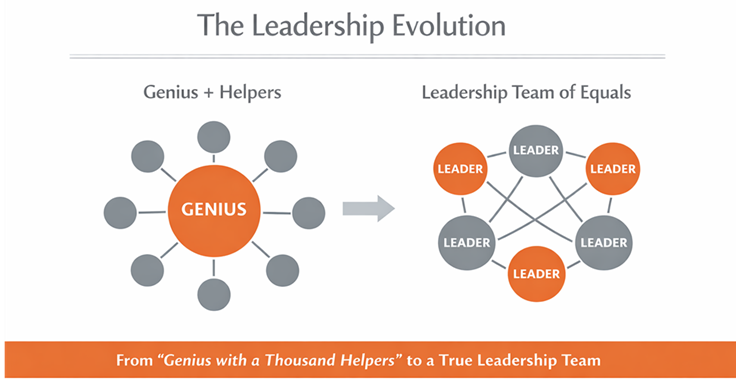
The company has to evolve into something different: a true leadership team.
A team where each leader fully owns their seat.
A team that debates issues openly.
A team that solves problems together rather than waiting for direction.
This is one of the most important transitions we work through when implementing EOS.
It requires clear structure through the Accountability Chart, the right people in the right seats, and the discipline of running the business through tools like Scorecards, Rocks, and Level 10 Meetings.
When that shift happens, the energy of the business changes.
The founder or CEO no longer has to be the hub of every decision.
Leaders begin to lead.
And the company starts gaining consistent traction on its vision.
The genius doesn’t disappear.
But instead of being surrounded by a thousand helpers, they’re supported by a leadership team capable of carrying the vision forward together.
A question for leadership teams:
Is your business still operating around a “genius with a thousand helpers,” or are you building a true leadership team capable of carrying the vision forward together?
These are the kinds of leadership transitions we work through during EOS implementation sessions.